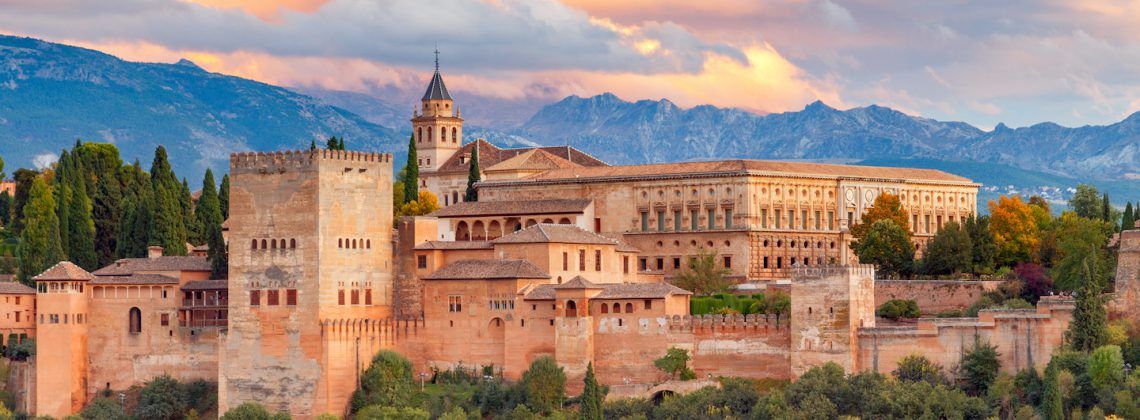
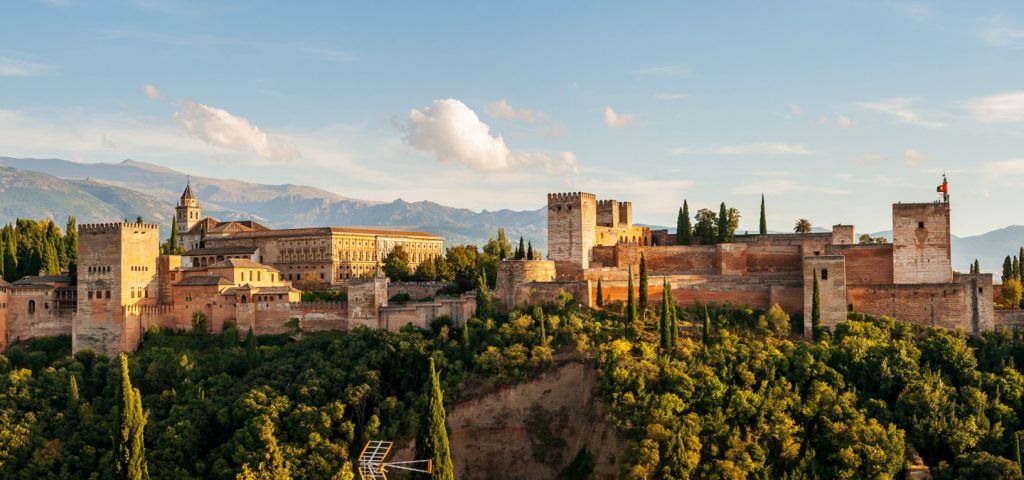
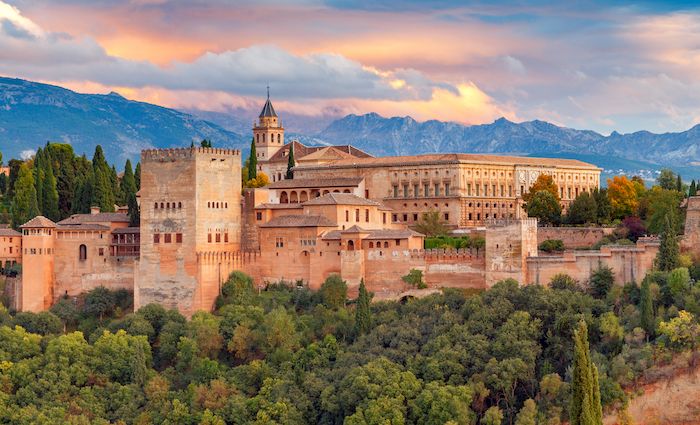
The Alhambra is one of Spain’s great cultural and architectural treasures, a UNESCO World Heritage Site, and a rare example of Islamic architecture in Western Europe.But did you know this iconic site boasts a fascinating history of conquest, conflict, and cooperation between different faith communities? Discover the history of the Alhambra written by a historian!
Pro Tip: Planning a visit to the Alhambra in Granada? Bookmark this post in your browser so you can easily find it when you’re there. Check out our Granada guide for more planning resources, our top Alhambra tours for a memorable, stress-free trip, and how to visit the Alhambra.
Why the Alhambra is a UNESCO World Heritage Site: Importance & Significance
A UNESCO World Heritage Site since 1984, the Alhambra is the best-preserved monument of the period of Muslim control of the Iberian Peninsula. As scholar Robert Irwin explains, the term “Alhambra” is Arabic for “the Red one.” Moreover, red, or hamra in Arabic, refers to the distinct color of the Alhambra’s walls.
According to historian Brian Catlos, the Alhambra was and remains the iconic symbol of Nasrid dynastic power in Granada and Islamic Spain. It is also, as this short article explains, an architectural masterpiece and a rich fusion of various cultural influences from the Muslim world and Spain.
Built to be imposing and difficult to access high above Granada, the Alhambra initially served as a citadel. However, historian Brian Catlos says it later became part fortress part palatial complex for the Muslim Nasrid dynasty that ruled Granada between the early 13th century and 1492.
Scholar Robert Irwin explains that Nasrid court poets described it as a “pearl set in emeralds.” This pearl became the crowning symbol of the Christian victory in the Reconquista (Reconquest) of Spain from Muslim rulers in 1492.
The History of the Alhambra: Origins and Key Events
You’re probably familiar with the year 1492 because of Christopher Columbus and what he did for Spain. However, 1492 is important in Spanish (and European) history for more than that Columbus voyage.
In that landmark year, scholars like Colin Turner remind us that the Christian Reconquista (Reconquest) of the Iberian Peninsula from Muslim rulers concluded with the fall of the Alhambra in Granada.
Granada’s conquest in 1492 stands as one of the movement’s crowning achievements. Catholic monarchs Ferdinand and Isabella’s seizure of the Alhambra complex certainly stands as one of the major symbols of the Reconquista. With a history like that, exploring the Alhambra yourself should be at the top of your list of things to do in Spain.
However, the story of the Alhambra is so much more than the dramatic backdrop of this major historical event. In fact, the Alhambra has more connections to American history than the famous year 1492.
The Alhambra’s Origins: Muslim Rule in Medieval Spain (711-1212 AD)
Conquerors | Dynasties | Cultural Centers
The Alhambra’s story begins centuries before its heyday between the mid-13th and late-14th centuries. In fact, its history takes shape with the arrival of the first Muslim army to Spain in A.D. 711. Scholar Colin Turner says this Muslim army invaded Spain from North Africa. Moreover, these invaders marked the beginning of roughly 800 years of Muslim interaction and control across the Iberian Peninsula (modern Spain and Portugal).
But who were the Muslims of Medieval and Early Modern Spain? You may be familiar with the term “moor” or “moorish” to describe Muslim rule in Spain. However, this does not begin to describe the complexities of Islamic influence in the Iberian Peninsula.
Known as Andalusi or Moros, there was not a singular dynasty behind the centuries of Islamic rule in Spain. In fact, historian Brian Catlos tells us that many Andalusi were not foreigners. Instead, they were Muslim converts to Islam from the Iberian Peninsula.
Moreover, successive Muslim dynasties ruled large areas of Spain (then referred to in Arabic as al-Andalus). Over the centuries, historian Albert Hourani tells us these dynasties turned places like Cordoba, Seville, and Granada into impressive commercial, cultural, and intellectual centers.
The Alhambra stands on the site of earlier fortifications constructed by Muslim rulers as far back as the late A.D. 800s. Furthermore, these fortifications were built on earlier ancient Roman battlements in Granada. Later in the 11th century, historian John D. Hoag says the Berber Zirid dynasty renovated the walls. However, the Alhambra did not take on its celebrated architectural and artistic features until the 14th century and Nasrid rule.
The Nasrid Dynasty: Building the Alhambra Palace (1212-1362 AD)
Nasrid Dynasty | Conflict | Fragility
Scholars like Colin Turner describe a dizzying array and succession of Muslim dynasties that emerged in the Iberian Peninsula, warring amongst each other and Christian rulers between North Africa and the south of France. However, historian Brian Catlos says only the Nasrid dynasty of Granada remained by the early 13th century. These last Muslim rulers presided over the Alhambra’s construction between the mid-13th century and late-14th centuries.
As Brian Catlos explains, the Nasrids were relative upstarts in relation to other Islamic dynasties in Spain. As such, Nasrid rulers maintained a tenuous grip on power. In need of a symbol of their authority, successive Nasrid rulers turned to the Alhambra. As John D. Hoag explains, over time, Nasrid sovereigns turned the Alhambra into a city above the city of Granada, complete with an impressive royal court, military defenses, mosques, and public baths among other features.
The Golden Age of Construction: The Palaces of Yusuf I and Muhammad V (1362-1391 AD)
Alhambra Construction | Diverse Artisans | Projecting Power
Rising above Granada from the Sabika hill, the Alhambra originally served as a citadel. After his rise to power in the early 13th century, Nasrid sultan Muhammad I began renovations of the Alhambra.
According to Brian Catlos, the Alhambra’s characteristic splendor mostly took shape between the reigns of Yusuf I (1333-1354) and Muhammad V (1354-1359, 1362-1391). Yusuf I’s monumental “Gate of Justice” still stands. However, Yusuf’s son, Muhammad V, replaced much of the original throne room and royal quarters.
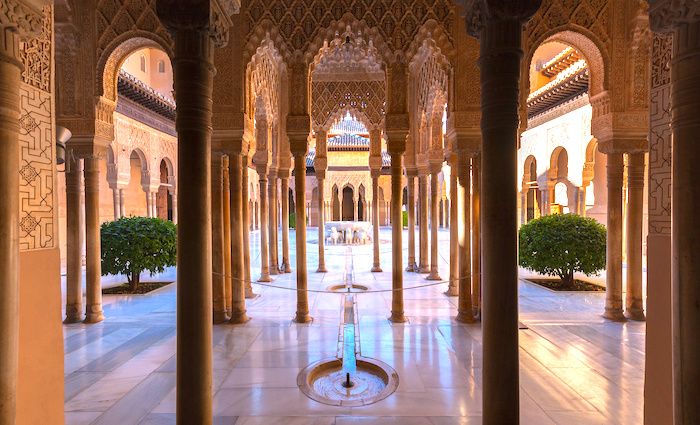
Under Muhammad V, historian Albert Hourani says two connected complexes were built. Known as the Comares Palace and the Court of the Lions respectively, these two areas are the Alhambra’s centerpieces. The latter, according to architectural historian John D. Hoag, appears to have been a combination of madrasa (Islamic theological school), convent for Sufis, and future mausoleum for the ruler.
Many different types of laborers, artisans, and craftsmen worked on the construction of the Alhambra. For example, historian John D. Hoag explains that Nasrid, Maghribi (North African), and Castilian Christian artisans harnessed innovative plaster-casting techniques to create the richly decorated interiors. These artisans also created complex geometric patterns, vibrant ceramic tiles, and intricately carved woodwork throughout these complexes.
Art & Conflict: The Alhambra Before the Reconquista (1391-1491 AD)
Complex Functions | Design Marvels | Reconquista
Historian Brian Catlos says Christian artists from Castile added paintings of chivalry and hunts to the interior. At the same time, other areas featured inscriptions from Koranic verses. Interiors also included poetry by court poets Ibn al-Khatib and Ibn Zamrak originally produced for this purpose. In other words, the Alhambra incorporated diverse artistic elements and reflected creative cooperation between different communities in Islamic Spain.
Historian John D. Hoag says impressive reception halls were interspersed with elaborately decorated bubbling fountains and balconies overlooking Granada and the Sierra Nevada mountains. According to the poet Ibn Zamrak, the Sabika hill was “the crown on the forehead of Granada, and the Alhambra (May God safeguard it!), the ruby at the peak of this crown.”
However, Nasrid rulers faced serious challenges from rising Christian rulers across Iberia. The Reconquista (Reconquest) began as early as the 9th century A.D. as various Christian rulers waged war on Muslim dynasties across the Iberian Peninsula. However, as Colin Turner explains, the Reconquista reached its height in the 14th and 15th centuries.
The Fall of Granada: The Alhambra After the Reconquista (1491-1815)
Reconquista Endgame | New Ownership | Transformation
The united Catholic monarchs Ferdinand and Isabella launched a decisive assault on Granada in 1491. Unable to keep the invaders at bay, Nasrid ruler Muhammad XII decided to surrender. Scholar Colin Turner says that on the night of January 1-2, 1492, Muhammad XII invited Christian Castilian forces inside the Alhambra. The official surrender of Granada and the Alhambra took place on January 2, 1492.
Although the fall of Granada and the Alhambra marked the end of Islamic rule in Spain, it did not end Muslim presence in Iberia. In fact, as historian Brian Catlos reminds us, Muslim minorities (called Moriscos) remained in Spain until the 17th century.
The Alhambra experienced several changes in the aftermath of Nasrid rule. For instance, scholar Iain Zaczek says Holy Roman Emperor Charles V had a palace and chapel built in 1527 within the Alhambra’s walls.
Unfortunately, changes to the Alhambra’s appearance in later centuries also came in the form of damage from warfare. For example, historian John D. Hoag mentions that the Alhambra sustained damage during the Napoleonic Wars (1803-1815). In general, Hoag continues, the Alhambra faded into obscurity and neglect.
The Alhambra Today: Restoration & Washington Irving’s Influence (1815-Present)
American Connection? | Restoration | Modern Tourist Attraction
I promised more American history connections and here it is. Are you a fan of characters like Rip Van Winkle, Ichabod Crane, and the Headless Horseman? They are all products of the famous 19th-century American writer Washington Irving. So, what does Irving have to do with the Alhambra?
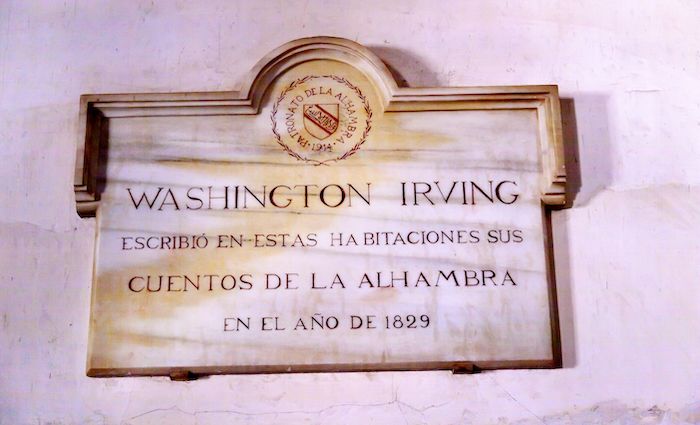
Well, Washington Irving became a 19th-century version of a social media influencer when it came to the Alhambra. Scholar Robert Irwin tells us that alongside a Spanish traveling companion, Irving toured much of Spain in 1828-1829. However, the Alhambra captivated Irving above all else. He even stayed within the palace, producing a book titled “Tales from the Alhambra.”
Thus, Irving’s book and fame helped introduce the Alhambra to new audiences across Europe and the US. Over subsequent decades, restoration work began on the Alhambra. Today, you’ll find a plaque dedicated to Washington Irving there. And that is the story about how one famous American author helped spark the Alhambra’s contemporary story as a popular tourist destination and iconic architectural treasure.
Guided Tours to Learn About the History of the Alhambra
The history of the Alhambra is a lot to take in and make sense of, which is why a guided tour is absolutely the best way to visit the Alhambra. Check out our favorite options below!
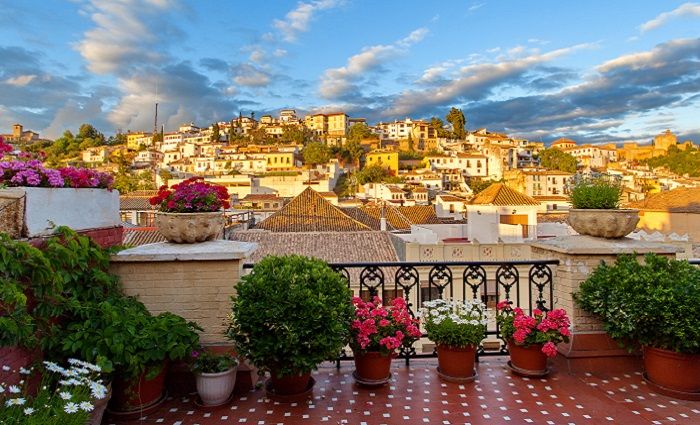
Granada, Spain, is worth visiting to see the massive Alhambra. Find out where our local experts recommend staying in this ancient city. You’ll find great hotel deals that will make your stay memorable.
Dale Pappas has a Ph.D. in Modern European History from the University of Miami. He specializes in the history of tourism and the Mediterranean region. Originally from Philadelphia, Dale has lived, studied, and worked across Europe. He currently lives between Miami and Athens, Greece.