Towering over the Bay of Naples, Mt. Vesuvius offers one of the most unforgettable day trips in Italy. Whether you’re visiting from Rome, Naples, or the Amalfi Coast, this guide covers everything you need to know. Get insider tips on how to reach Mt. Vesuvius, when to go, what to see, and how to combine it with Pompeii.
Mt. Vesuvius is famous for one catastrophic eruption that buried entire cities and immortalized Roman life in ash. Visiting the summit gives you a front-row seat to both its dramatic history and the crater that caused it all.
If you’re not joining a tour that includes transportation or renting a car, getting to Mt. Vesuvius takes some effort (there’s no direct train or metro to the crater). Here are your options:
From Rome:
Train: Take the high-speed train from Roma Termini to Napoli Centrale (just over 1 hour, runs every 20 mins).
Local Transport: From Napoli Centrale (Piazza Garibaldi), take the Circumvesuviana train toward Sorrento or Poggiomarino and get off at either:
Ercolano Scavi: From here, grab a taxi or shuttle up to Vesuvius.
Pompei – Villa dei Misteri: From here, catch the EAV bus to the volcano.
From Rome, take the A1 south to Naples, then exit at Ercolano. Follow signs to the Vesuvius parking lot at 800 meters elevation (about 20 minutes from the exit). From there:
Walk 30 minutes (1.8 km) to the 1,000-meter lot
Or take the municipal shuttle (€1 each way, 4 minutes)
From the Amalfi Coast
Train: Take the Circumvesuviana from Sorrento toward Naples. Get off at Pompei – Villa dei Misteri, then connect to the EAV bus up to Vesuvius.
By Car: Follow the same driving route as from Rome via Ercolano.
So, how much will a visit to Mt. Vesuvius set you back? The ticket price is pretty low, and you can purchase them directly through the Parco Nazionale Del Vesuvio website. Just keep in mind these tickets do not cover transport or a guided tour.
Admission: 10€ | 8€ for under 25 years old with a valid ID
Mt. Vesuvius Hours:
January, February, November, December: 9 AM – 3 PM
March, October: 9 AM- 4 PM
April, May, June, September: 9 AM- 5 PM
July, August: 9 AM- 6 PM
Mt. Vesuvius Tour Options
We are a tour company, so we always recommend joining a tour, not only to keep our lights on but also because we believe it is by far the best way to see Mt. Vesuvius. You can definitely DIY Mt. Vesuvius, but you will get much more out of your time with a local, expert guide. Check out some options:
How Long to Budget for Your Visit
If you’re coming from Rome, plan for a full-day adventure—around 12 hours round-trip, including Pompeii, lunch, and hiking time. From Naples or the Amalfi Coast, you’ll want to set aside at least 8 hours (including transport).
Once you’re on the mountain, the hike to the crater takes about 30 minutes, but if you want to explore more, the Vesuvius National Park offers 9 scenic trails. The most popular path is Trail #5, which leads straight to the crater rim. If you’ve got the time, consider adding one or two of the other loops—like Trail #1 or Trail #6—for panoramic views.
Top Things to See At Mt. Vesuvius
Climbing to the crater of Mt. Vesuvius is the main attraction, but it’s not the only reason to visit. The surrounding area is filled with fascinating sites shaped by the volcano’s eruptions, both ancient and modern.
The Crater
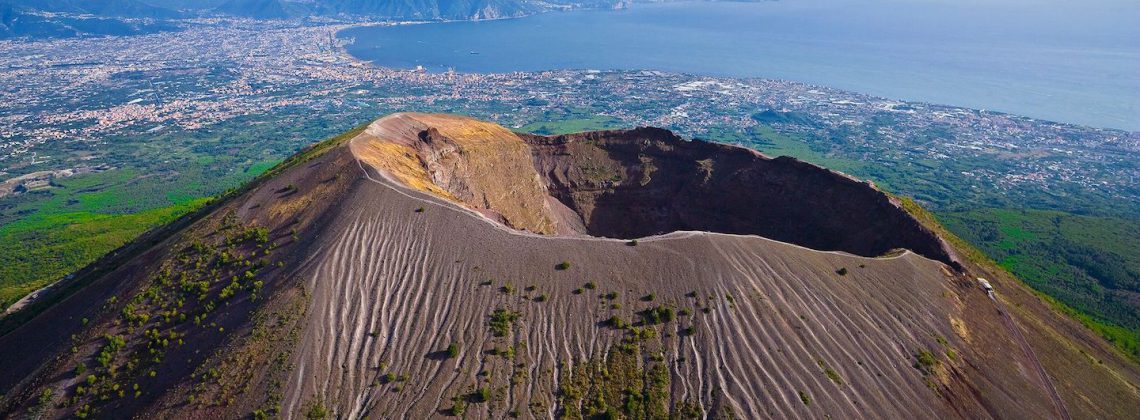
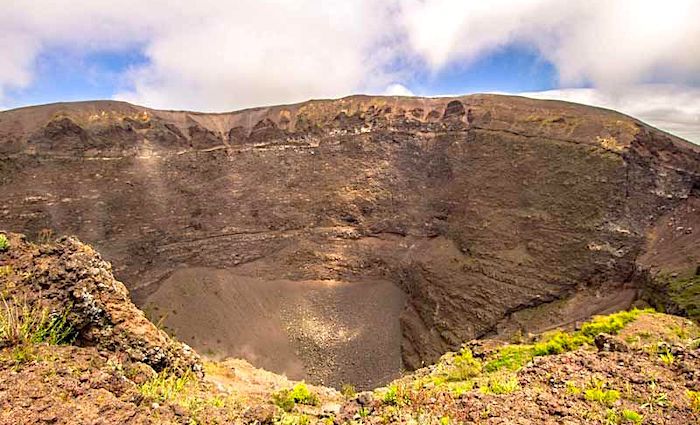
The crater is the main draw for most visitors, and reaching it feels like a real accomplishment, even if the hike isn’t overly difficult. The easiest and most direct route is Trail #5, Il Gran Cono, which begins at 1,000 meters above sea level. From there, it’s a 130-meter ascent to the rim, with panoramic views and layers of volcanic rock revealing the mountain’s explosive past. For those who’ve already explored Pompeii, standing at the edge of the crater offers a powerful perspective on the sheer force of nature that buried an entire city in ash.
Pompeii
This thriving Roman port city met its tragic end on August 24th, 79 AD, when Mt. Vesuvius erupted and launched a 10-mile-high plume of ash and pumice into the sky. Thousands were killed—not just by lava or falling debris, but by toxic gases that suffocated the city. Ironically, that same volcanic ash helped preserve Pompeii in extraordinary detail.
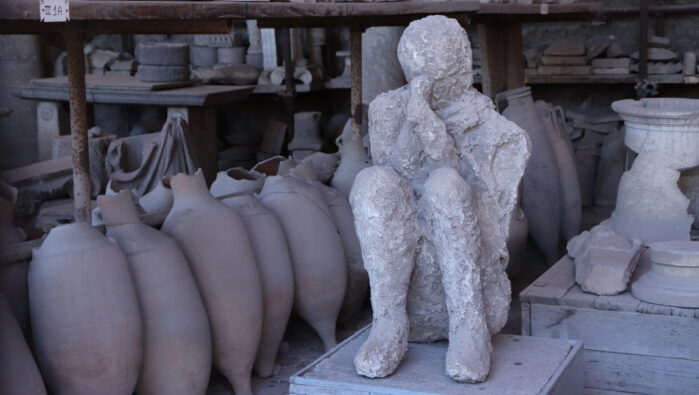
Today, visitors can walk through remarkably intact streets, homes, shops, and even view haunting plaster casts of victims frozen in time. It’s one of the most intimate and vivid glimpses into daily life in the ancient Roman world.
Herculaneum
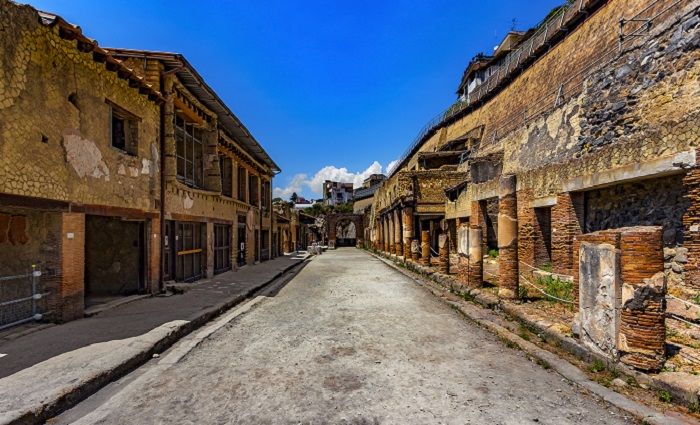
Herculaneum is the smaller, lesser-known sister city to Pompeii, accidentally discovered in 1709. Like Pompeii, it was buried under ash and lava during the eruption of Mt. Vesuvius, preserving buildings, mosaics, and even organic materials. Today, it’s recognized alongside Pompeii as a UNESCO World Heritage site. One of its most fascinating discoveries is the Villa dei Papiri, where archaeologists unearthed a library of ancient papyri preserving the works of Greek scholars.
Boscoreale
Located at the foot of Mt. Vesuvius and just north of Pompeii, this town was once dotted with Roman villas and farms thanks to its fertile volcanic soil. Today, the two main sites to visit are the Antiquarium and Villa Regina. The Antiquarium, established in 1991 next to the archaeological site, displays artifacts uncovered during local excavations and offers insight into daily life in the Vesuvian countryside. Right next door, Villa Regina—preserved by volcanic ash—provides a clear glimpse into what rural Roman villas once looked like. While only parts of the structure remain, it still paints a vivid picture of life in ancient times.
Top Hotels in Rome
Bio Hotel Raphael ⭐⭐⭐⭐⭐
Piazza Navona • Terrace
Luxury hotel with a rooftop restaurant plus spacious and calming suites near Piazza Navona.
Mount Vesuvius formed due to the collision of the Eurasian and African tectonic plates, roughly around 25,000 years ago. Though several eruptions occurred prior to 79 AD, this eruption is widely considered one of the most catastrophic volcanic eruptions of all time.
In 62 AD, a powerful earthquake destroyed a great deal of the Bay of Naples area, Pompeii included. Much of that destruction was not even repaired, come the 79 AD eruptions.
The Most Famous Eruption of All Time
The events of the 79 AD eruptions are famously recounted by Pliny the Younger in two letters written to another historian named Tacitus. Combined with geological evidence, much of the information we have now about Mount Vesuvius and its 79 AD eruptions is thanks to Pliny the Younger, the only surviving eyewitness account of these events.
In the letters, Pliny the Younger describes the last days of Pliny the Elder, his uncle. As Pliny the Younger writes, Pliny the Elder noticed early volcanic activity occurring across the Bay of Naples and organized a rescue mission. He describes how his uncle died due to a mass of sulfurous gas.
One of the best Mount Vesuvius facts: the term “Plinian eruption” comes from the account of Pliny the Younger. These eruptions created a column of volcanic ash and gases that can rise miles into the Earth’s atmosphere and into the stratosphere. These eruptions are also widely known as “Vesuvian eruptions.”
Mount Vesuvius Subsequent Eruptions
Geologists believe there were three significant Mount Vesuvius eruptions prior to the one in A.D. 79, most famously one in 1800 B.C., which engulfed a number of Bronze Age settlements. Until about 1631, geologists and historians believed the volcano erupted about a dozen times, with varying severity.
In 1631, however, the volcano entered a period of frequent volcanic activity. From 1631 to the end of the nineteenth century, Mount Vesuvius erupted fifteen times, most violently in 1872. The most recent eruption occurred in 1944.
Could Mount Vesuvius Erupt Again?
Yes, Mount Vesuvius is considered an active volcano. It very well could erupt again. Mount Vesuvius sits on top of an extremely deep layer of magma that goes 154 miles into the earth.
So, the next Mount Vesuvius eruption will happen, and it won’t be pretty. Geologists think that the volcano is overdue for an eruption.
Luckily, the Vesuvius Observatory is constantly monitoring the volcano’s seismic activity. So, if it were to happen again, the local communities would have more warning and would have enough time to evacuate.
Top Tours in Rome
Questions About Visiting Mt. Vesuvius
Is Mt. Vesuvius still active?
Yes—while it hasn’t erupted since 1944, Vesuvius is classified as an active volcano and is closely monitored.
Can I visit Pompeii and Mt. Vesuvius in one day?
Absolutely—plan an early start; explore Pompeii in the morning, then head up to Vesuvius for an afternoon hike.
How long does the hike to the crater rim take?
From the upper car park it’s roughly a 30-minute uphill walk; allow 2–3 hours total for the visit.
Do I need to buy Mt. Vesuvius tickets in advance?
Booking online is smart in high season, as daily visitor numbers are capped and time slots can sell out.
What’s the best time of year to climb Vesuvius?
April–June and September–October offer mild weather, lighter crowds, and clearer Bay of Naples views.
Final Thoughts: Visiting Mt. Vesuvius
A volcano that buried whole cities deserves more than a last-minute stop. Lock in transport, book your entry slot, and arrive early so you can savor the summit without the crowds.
Brandon is a co-founder and owner of The Tour Guy and its subsidiary The Roman Guy. He left the States to travel the world at 18 and never looked back! As an official Tour Guide of Rome and Certified Sommelier, he loves to travel the world and share these experiences with his readers.
Reader Interactions
Comments (7)
Sarah Little
Pompeii & Mt. Vesuvius Day Trip: From Rome link doesn’t work. Do you have another recommendation for a day trip from Rome?
Thanks – Sarah
Do you know where we can actually purchase tickets to enter Vesuvius national park? I’ve read some things that say due to covid you must buy them before you get there but all the websites I visit don’t have them available. We are looking at July 13 specifically.
Thanks!
Mt. Vesuvius is open year-round, but the path can close at times due to bad weather or thick fog. It’s best to play it by ear and have a back up plan in case the weather doesn’t play nice. There is a great museum there you can visit if the weather isn’t great that day.
I am planning on going to Pompeii and taking the EAV local bus to Mt Vesuvius and my idea is to take a local/public bus to the Ercolano Scavi train station to go back to Naples but have been unable to find if there is a local bus [EAV] from Mt Vesuvius back Ercolano Scavi. Can you help me?





















Pompeii & Mt. Vesuvius Day Trip: From Rome link doesn’t work. Do you have another recommendation for a day trip from Rome?
Thanks – Sarah
Thanks a million for spotting that. I think i fixed it. Here is the link. https://theromanguy.com/tours/italy/rome/pompeii-vesuvius-private-day-trip-from-rome
Its a private tour, so its more expensive. If you are looking for something on the cheaper side we have a small group tour of Pompeii which does NOT include Vesuvius but still very cool. https://theromanguy.com/tours/italy/rome/rome-to-pompeii-day-trip
Do you know where we can actually purchase tickets to enter Vesuvius national park? I’ve read some things that say due to covid you must buy them before you get there but all the websites I visit don’t have them available. We are looking at July 13 specifically.
Thanks!
Hi! Shoot us an email info @ TheTourguy.com
Hello! I was just wondering if you’re able to climb Mt. Vesuvius during March? I’m getting a lot of contradicting answers!
Thanks so much ☺️
Mt. Vesuvius is open year-round, but the path can close at times due to bad weather or thick fog. It’s best to play it by ear and have a back up plan in case the weather doesn’t play nice. There is a great museum there you can visit if the weather isn’t great that day.
I am planning on going to Pompeii and taking the EAV local bus to Mt Vesuvius and my idea is to take a local/public bus to the Ercolano Scavi train station to go back to Naples but have been unable to find if there is a local bus [EAV] from Mt Vesuvius back Ercolano Scavi. Can you help me?