

With a lift network that connects you to Italy, runs that top out at nearly 4,000 meters, and a ski village so charming it banned cars, it’s easy to see why Zermatt is the crown jewel of European skiing. It’s expensive, yes—but compared to Vail or Aspen, skiing Zermatt it’s surprisingly reasonable, especially once you factor in the food and accommodation. This guide covers how to ski Zermatt, including getting there, where to stay, which lift tickets to buy, and which runs to tackle first. Ready to hit the slopes?
Why Ski Zermatt, Switzerland
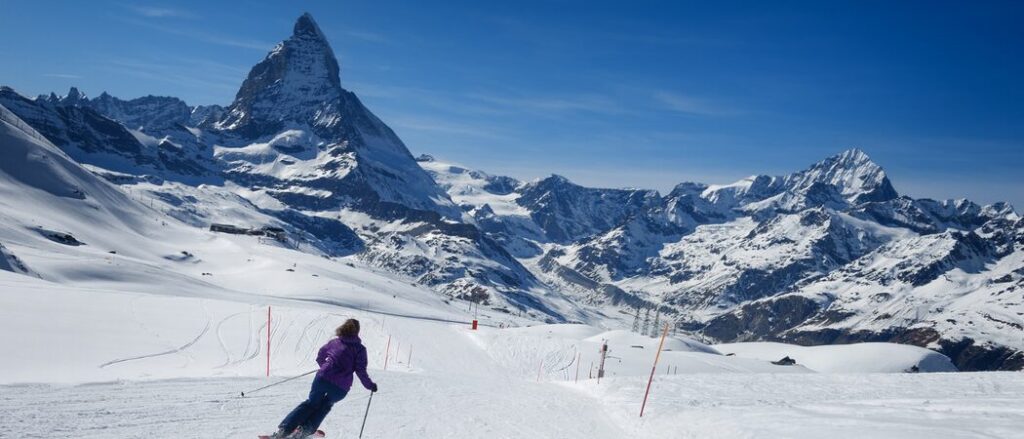
So, why should you pack up your boots and fly halfway around the world to ski at Zermatt? Good question—and here’s why:
- High-altitude terrain: With slopes reaching up to 3,883 meters, Zermatt has one of the longest ski seasons in the Alps and snow conditions that hold up well into April.
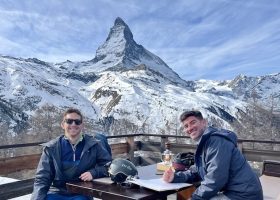
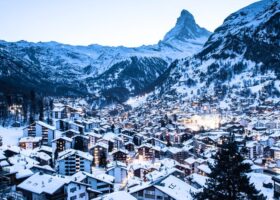
- The Matterhorn is your backdrop: You’re skiing in full view of one of the most recognizable peaks in the world, and the village is car-free.
- Ski to Italy for lunch: The international lift pass connects you to Cervinia, where the sun shines longer and the pasta’s cheaper.
- Food on and off the mountain is excellent: Think wood-fired rösti at altitude, après-ski fondue, and over 40 on-mountain restaurants worth stopping for.
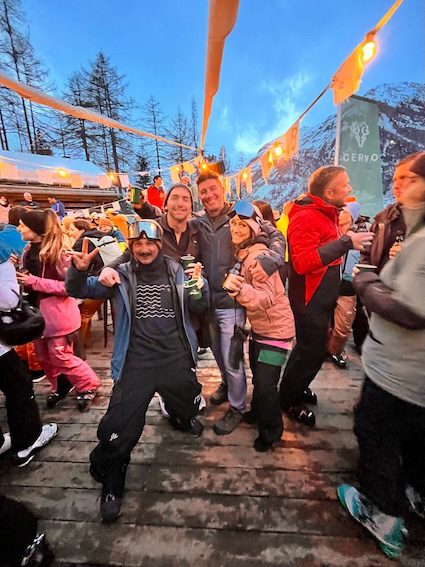
- Apre ski is on point: Not only is there live music and alpine chalets with patios all over the mountain, but multiple excellent Apres Ski options from Hennu Stall Après-Ski Bar to Cervo.
- Costs that make sense: Once you total flights, passes, beds, and meals, you’ll spend noticeably less than in Aspen or Vail.
- Non-ski activities: Thermal baths, horse-drawn sleigh rides, snowshoeing, and scenic train rides make your off-days just as magical.
How to Get to Zermatt Ski Resort
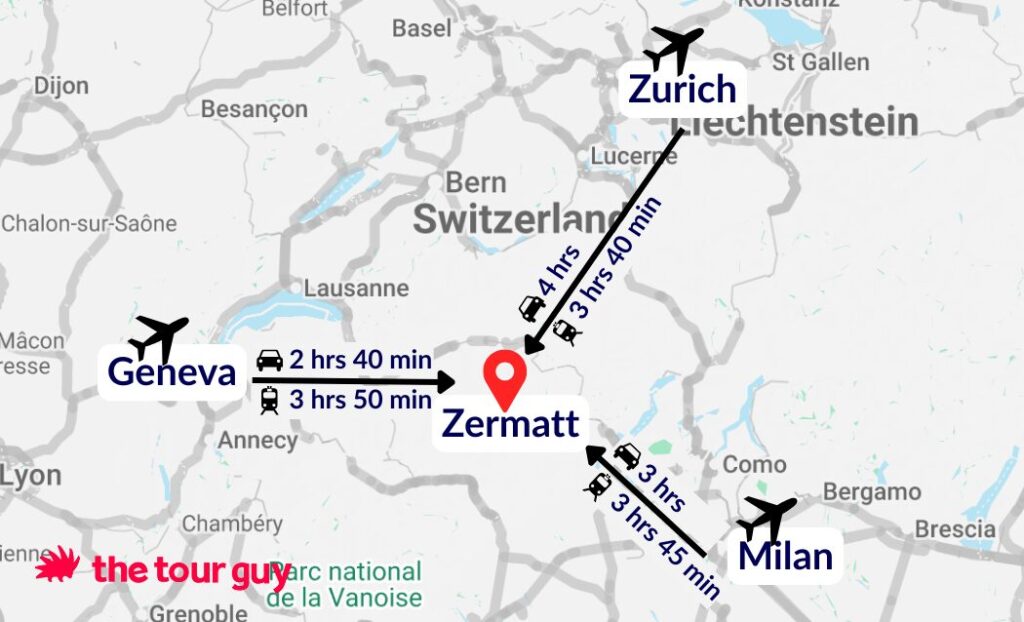
Zermatt is tucked into southern Switzerland near the Italian border and easily reachable from the Geneva Airport (GVA), Zurich Airport (ZRH), and Milan Airport (MXP). All three airports work, but Zurich and Geneva are especially convenient because their rail stations sit inside the terminal. You can roll your bags from arrivals straight onto the train!
By car: You’ll need to park in Täsch, the last town before Zermatt, and take a 12-minute cogwheel train into the village. Drive times are approximately:
- 2 hr 40 min from Geneva
- 4 hr from Zurich
- 3 hr from Milan
By train: This is the easiest option for most, thanks to Zermatt’s direct rail connection. Travel times are approximately:
- 3 hr 50 min from Geneva
- 3 hr 40 min from Zurich
- 3 hr 45 min from Milan
Zermatt Lift Tickets
Zermatt uses a dynamic pricing model, so ski pass prices change based on the time of season and how far in advance you book. The earlier you buy, the better the price.
Zermatt Ski Pass Options
There are lots of options for Zermatt ski passes. Here are the most popular ones:
| Pass Type | 1-Day | 2-Day | 3-in-5 Days | 4-in-6 Days |
| Zermatt Only | CHF 88 (110 USD) | CHF 145 (180 USD) | CHF 251 (310 USD) | CHF 334 (413 USD) |
| International (Zermatt + Cervinia) | CHF 103 (127 USD) | CHF 158 (195 USD) | CHF 290 (360 USD) | CHF 387 (480 USD) |
Our take: Get the International pass if you’re staying for more than one day. It’s not much more expensive and gives you access to Cervinia and Valtournenche, which can be sunnier and less windy.
Other Ticket Types
- Beginner Area Pass: Access to beginner zones like Sunnegga and Leisee
- Pedestrian/Hiker Pass: For non-skiers who still want access to mountain restaurants and viewpoints
- Reuctions: Free ski pass for kids under 9, 50% off for children under 16, and 15% off for anyone under 20.
Zermatt lift passes are available through the Matterhorn Paradise website.
Zermatt Ski Area Explained
Zermatt is massive. We’re talking 54 lifts, 360 km (224 miles) of skiable terrain when you include Cervinia, three major access points, off-piste routes, and a year-round freestyle snowpark.
If it’s your first visit, the best way to get your bearings is to learn the three main access points up the mountain. Each one connects you to a different part of the resort, and understanding where they lead will help you plan your days (and stay close to the right lift).
Sunnegga–Rothorn
- Best for: Families, intermediates, beginners, and sunny slopes
- Accessed via: Underground funicular from the center of Zermatt
- Overview: This is the best area for relaxed, scenic skiing. Beginners should head straight to Wolli’s Park, a gentle and well-designed area with ski schools and Matterhorn views. Intermediates will find cruisy reds higher up toward Blauherd and Rothorn.
Gornergrat
- Best for: Intermediates, long cruisers, and Matterhorn views
- Accessed via: Gornergrat cogwheel railway (also a scenic ride in itself)
- Overview: Gornergrat is a dream zone for intermediate skiers with wide, rolling red runs and plenty of space to spread out. Take the train all the way up and enjoy long descents with postcard-worthy views. From here, it’s easy to connect to Riffelberg (another beginner-friendly spot) or make your way toward Sunnegga and beyond.
Matterhorn Glacier Paradise
- Best for: Advanced skiers, off-piste, glacier skiing, and access to Cervinia, Italy
- Accessed via: Matterhorn Express gondola + 3S cable car
- Overview: This is the highest ski area in Zermatt—and in all of Europe. From Klein Matterhorn, you’ll have access to steep glacier runs, challenging off-piste terrain, and the lift connection to Cervinia in Italy. Advanced skiers should make a point to hit Stockhorn and Triftji, known for their moguls and freeride lines. This zone is also home to the Zermatt Snowpark.
Where to Stay for Skiing in Zermatt
You really can’t go wrong when it comes to deciding where to stay in Zermatt. The village itself is compact, and with three lift bases, you’re never too far from the slopes. Even so, there are still a few things to keep in mind. For a detailed guide, check out our article: Where to Stay in Zermatt, Switzerland
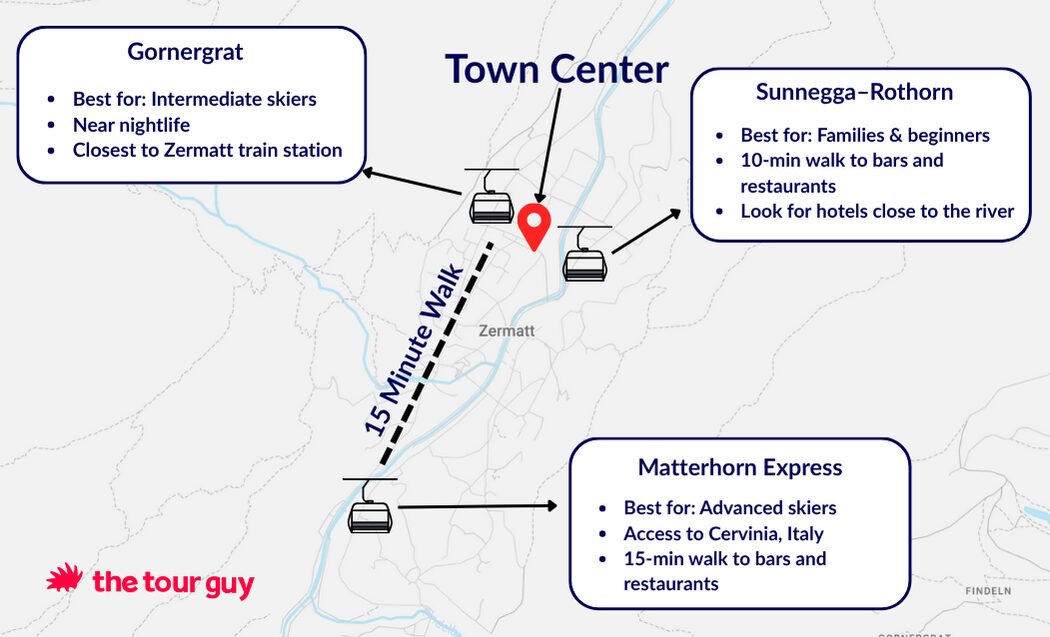
- North end (Sunnegga) is lively. Short walks to bars and the funicular, but foot traffic can be heavy.
- Center (Gornergrat) simplifies arrival. Roll your bags off the main train and you’re home. Ideal for mixed-ability groups and shorter or budget stays.
- South end (Matterhorn Express) is quiet. You’ll finish each ski day at your doorstep, however, you’ll need to walk 15–minutes or take a taxi to get to the main bars and restaurants.
- True ski-in/ski-out is rare but magical. Places like Riffelalp or slopeside chalets near Findeln offer it. Just book early and be ready for a lift ride to dinner.
Top Hotels in Zermatt
Cervo Mountain Resort ⭐⭐⭐⭐⭐
Apres-Ski • Spa/Sauna • Steps from Sunnegga Funicular
Tucked just above town, Cervo has an alpine luxury mixed with casual cool feel, complete with live music, mulled wine, and insane views.
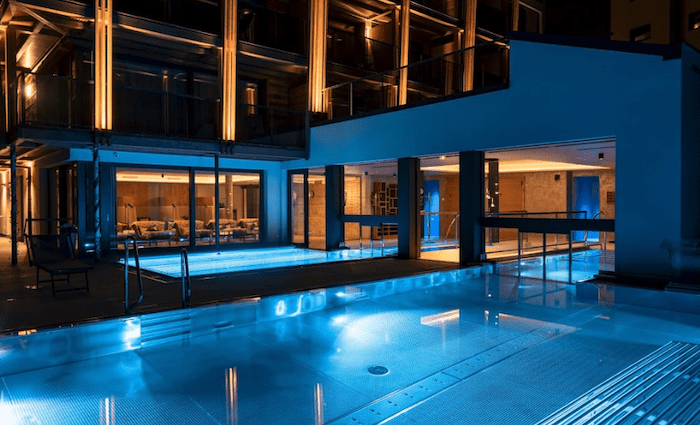
Resort La Ginabelle ⭐⭐⭐⭐
Family-Friendly • Spa/Sauna • 200m from Sunnegga Funicular
Big on comfort without blowing the budget, Ginabelle’s heated pools, hammam, and Matterhorn views make it a top-value stay.
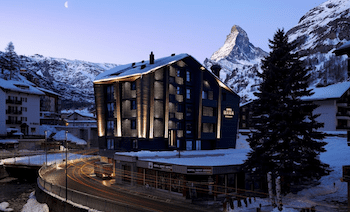
Hotel Zermama ⭐⭐⭐⭐
Swanky Vibe • Spa/Sauna • 150m from Sunnegga Funicular
The bar’s a local favorite, the vibe is upscale but welcoming, and you’ll be on the slopes in minutes.
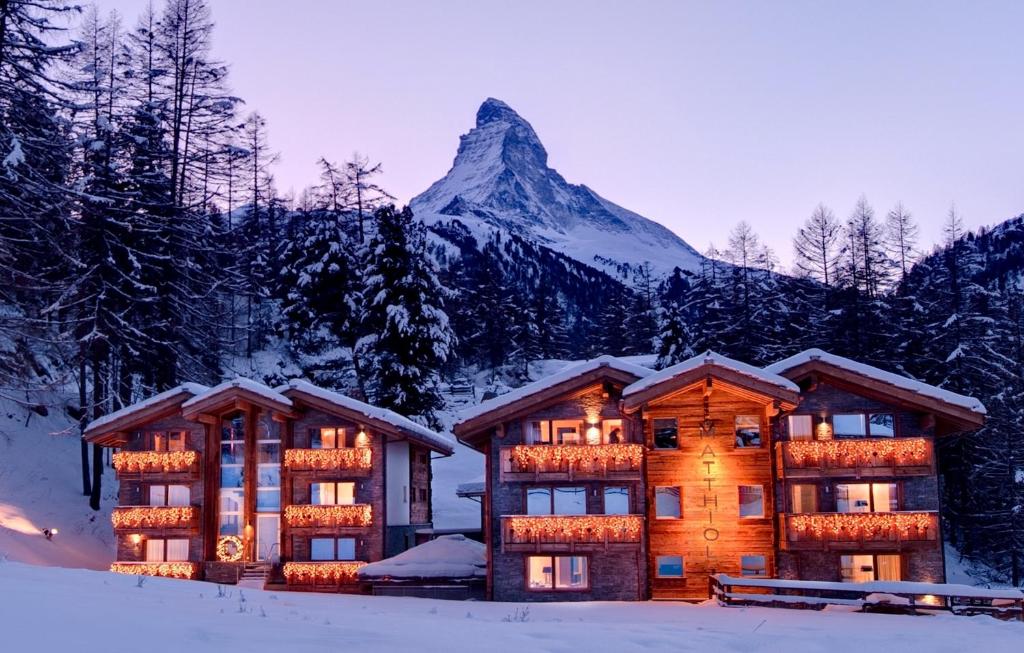
Matthiol Boutique Hotel ⭐⭐⭐⭐
Multi-Bedroom Units • Spa/Sauna • 800m from Matterhorn Express
A little higher up, but worth the walk for roomy suites, modern design, and everything you need to self-cater in style.
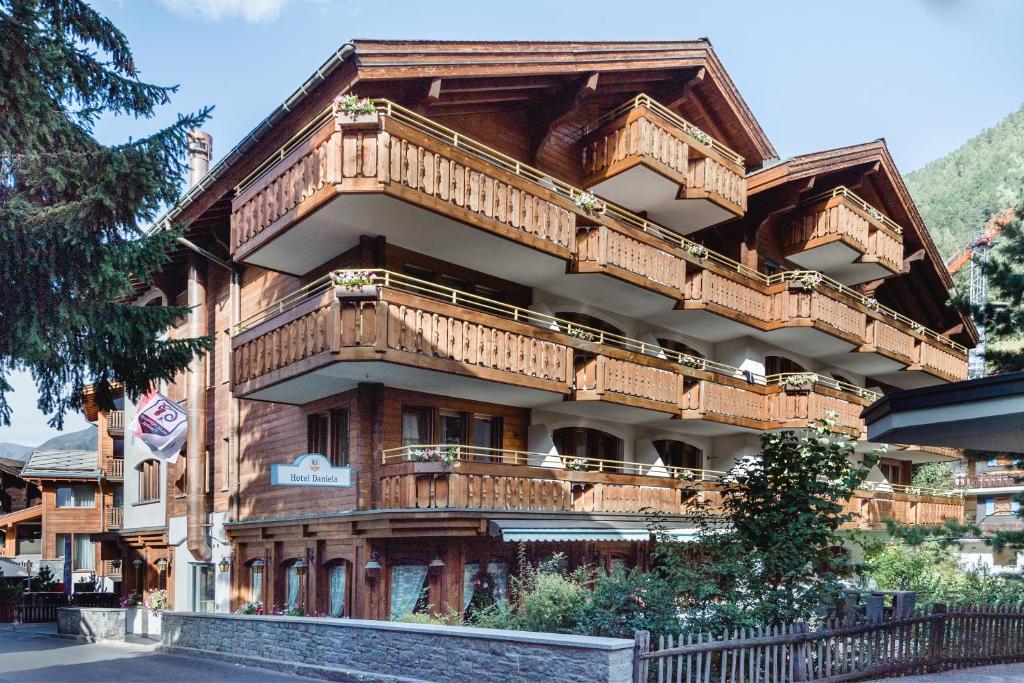
Hotel Daniela ⭐⭐⭐⭐
Classic Style • Spa/Sauna • 450m from Sunnegga Funicular
If you’re after that warm, wood-paneled Swiss vibe without sacrificing location or comfort, Daniela is your go-to.
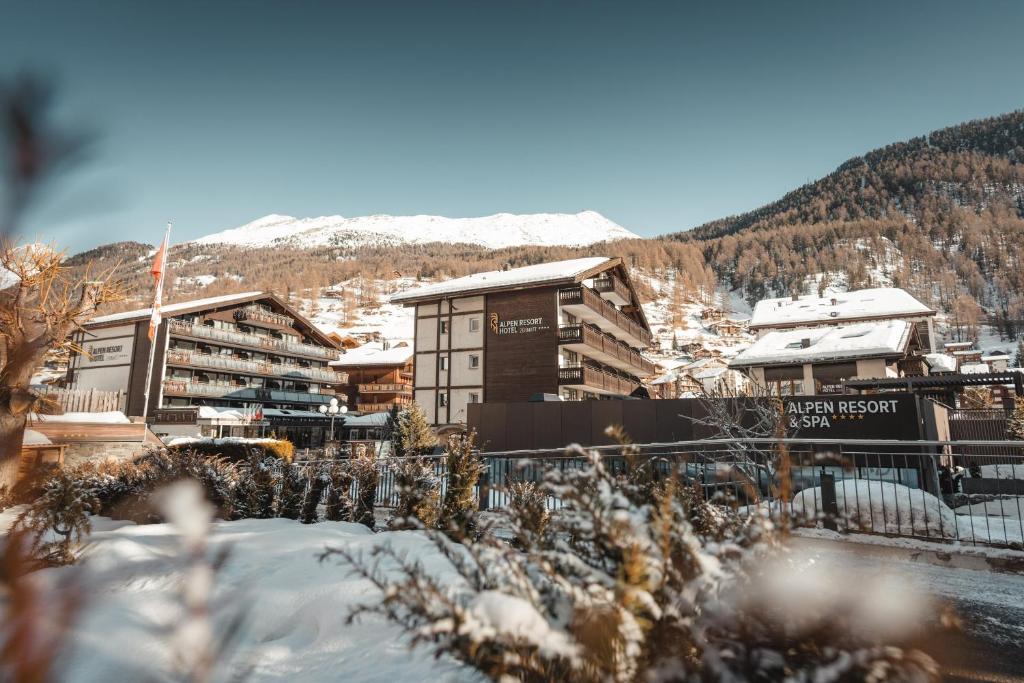
Alpen Resort & Spa ⭐⭐⭐⭐
Spacious Rooms • Free Station Shuttle • 350m from Gornergrat Lift
Perfect for families or longer stays, Alpen offers ski lockers, cable TV, multiple dining options, and free rides from the station.
More Things to Know About Skiing in Zermatt
How Much Does It Cost to Ski in Zermatt?
Zermatt isn’t cheap, but it’s not outrageous either, especially compared to Vail or Aspen. You can expect to spend 1,900 to 2,400 CHF (2,350 to 3,000 USD) per person for a comfortable week, excluding flights. Here’s the breakdown:
- 6-day International pass: ~565 CHF (700 USD)
- Mid-range hotel, half-board: 250–350 CHF per room per night (300 to 450 USD)
- Lunch on-mountain: 25–35 CHF (30 to 45 USD)
- Beer: 7 CHF on piste, 6 CHF in town (8 to 10 USD)
Is Zermatt Good for Families?
Yes, but it’s better for families with kids who already know how to ski. Beginners are best based near Sunnegga, where the terrain is flatter and ski schools are nearby. Hotels like La Ginabelle have Kids’ Clubs that are open late (we’re talking 10 pm) and also offer kid-friendly menus and family rooms. The electric shuttle system also makes it easy to move gear around. It’s not the cheapest family destination, but the infrastructure makes it less stressful once you’re there.
Is Zermatt Good for Non-Skiers?
Absolutely. Zermatt has winter hiking, sledding, thermal spas, shopping, and fine dining, plus pedestrian passes that let you meet your group for lunch on the mountain. It’s an ideal destination for couples or groups with mixed activity levels.
What’s the Best Month to Ski Zermatt?
January and February typically bring the best snow, with cold temps and solid coverage across the resort. March offers more sunshine and longer days without sacrificing too much snow quality. April can still be great, especially on the glacier and over in Cervinia. Early December is less reliable, with limited terrain open at lower elevations.
Coming from outside Europe? Buy an eSim in advance so you land with data already working. You’ll pay around €20 total with yesim instead of the usual $10 per day roaming charge.

Final Thoughts
Planning a ski trip to Zermatt takes a bit of effort, but once you’re there, it runs like clockwork. The terrain is massive, the lifts are fast, and the car-free village is straight out of a dream. Lift tickets aren’t cheap, but they unlock access to one of the most unique ski areas in Europe. Book your flights and accommodation early, and let Zermatt do the rest.
Want more? Check out our articles on the Best Winter Resorts For Your Ski Holidays in Europe and The Best Ski Hotels In Italy.