

Caesar was more than a man. He was a ruthless general, a brilliant politician, and a charismatic showman who changed Rome forever. He took a crumbling Republic and, through genius and brute force, paved the way for an Empire. This timeline of Julius Caesar cuts through the popular myths and shows how one man’s ambition redrew the map of the world.
Quick Context: The Time of Julius Caesar
Julius Caesar lived from 100 BCE to 44 BCE, a period when Rome was transitioning from a fragile Republic into a full-blown Empire.
- Before Caesar: Rome had already expanded across Italy and the Mediterranean but was torn apart by civil wars between generals like Marius and Sulla.
- During Caesar’s life: The Republic was collapsing under corruption, inequality, and elite power struggles. Caesar himself became both a product and destroyer of that chaos.
- After Caesar: His death didn’t restore the Republic—it opened the door for Augustus and the rise of imperial Rome.
Life & Timeline of Julius Caesar (100–44 BCE)
Here’s a chronological breakdown of Caesar’s life, from his scrappy birth in Rome’s rough Suburra neighborhood to his assassination on the Ides of March.
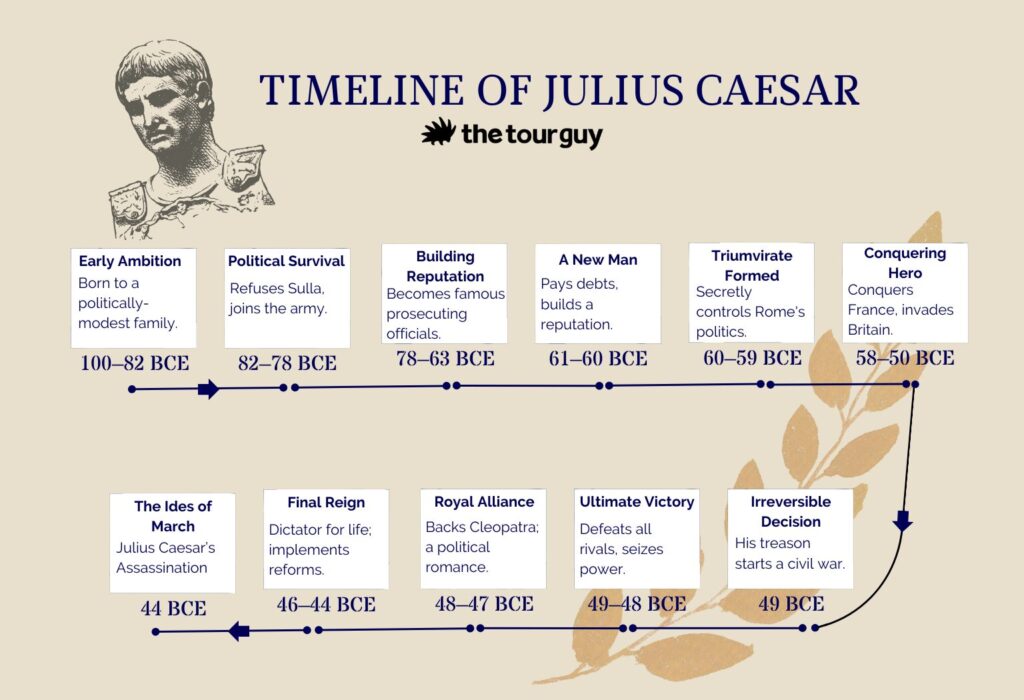
Birth and Early Life of Julius Caesar (100–82 BCE)
Julius Caesar was born into a patrician family with a famous name but not a lot of money or political power. From an early age, he was defined by his family’s connections and his own enormous ambition.
- Born in 100 BCE to the patrician but politically modest Julii family.
- Claimed legendary descent from Venus and the hero Aeneas.
- His aunt married the powerful populist general Gaius Marius, giving him a powerful connection.
- His father died when he was 16, making him the head of the family.
- Born in the rough Suburra area of Rome, in the area where the Colosseum stands today, he had to build his fortune and power from scratch.
Why this matters: This wasn’t a story of a boy born to be king. It’s the story of a man who used a powerful name and ruthless ambition to become one.
Surviving Sulla: Exile and First Medals (82–78 BCE)
At 18, Caesar found himself on the wrong side of the most powerful man in Rome. He was marked for execution and learned early on that political survival depended on more than just family ties. It depended on quick thinking and a lot of luck.
- In 82 BCE, dictator Sulla ordered Caesar to divorce his wife Cornelia, daughter of his enemy Cinna.
- Caesar refused, leading Sulla to strip him of his inheritance and priesthood.
- He narrowly avoided execution by fleeing Rome and joining the army in Asia Minor.
- He earned the civic crown, one of Rome’s highest honors, for saving a life in battle.
Why it matters: This early exile taught Caesar a lesson he’d never forget: if you want power, you have to seize it, not wait for it.
The Return: Lawyer, Showman, Rising Politician (78–63 BCE)
When Sulla died, Caesar returned to Rome and began to make a name for himself. He used his incredible speaking skills and a gift for public relations to win over the masses and climb the political ladder.
- After returning to Rome in 78 BCE, he gained fame by prosecuting corrupt officials.
- He was elected aedile for 65 BCE and put on extravagant games, including a gladiator show with 320 pairs of fighters in silver armor.
- In 63 BCE, he was elected Pontifex Maximus, Rome’s chief priest, a position he won with massive debt and political maneuvering.
Why it matters: This period cemented Caesar’s reputation as a man of the people who was willing to spend every last dime (and borrow more) to get what he wanted: public adoration and political power.
Spain Changes Everything (61–60 BCE)
By 61 BCE, Caesar was broke and deeply in debt. He needed a way out, and he found it by becoming governor of Hispania Ulterior (Farther Spain). In just two years, he transformed his financial situation and proved himself on the battlefield.
- He immediately launched a campaign against local tribes.
- His military victories provided massive loot, which he used to pay off all his debts.
- He was hailed as a hero by his soldiers and earned the right to a triumphal return to Rome.
Why it matters: His time in Spain gave him three things: money, a loyal army, and the kind of military glory he needed to compete with the likes of Pompey the Great.
The Power Pact: First Triumvirate (60–59 BCE)
Caesar knew he couldn’t seize power on his own. In a backroom deal that changed history, he allied himself with two of the most powerful men in Rome: Pompey the Great and Marcus Crassus.
- He formed a secret political alliance with his two rivals, known as the First Triumvirate.
- With their backing, he was elected consul in 59 BCE.
- He used his new power to pass laws that favored his allies and military veterans, infuriating the Senate.
Why it matters: This was a clear sign that Caesar was done playing by the rules. He was willing to bypass the traditional political system to get what he wanted.
Ten Years in Gaul (58–50 BCE)
With the support of the Triumvirate, Caesar was appointed governor of Gaul, kicking off a decade-long war of conquest that would make him the most powerful man in Rome.
- He launched a brutal campaign that conquered all of modern France, Belgium, and parts of Germany, even making two brief invasions of Britain.
- He documented his exploits in his Commentaries on the Gallic War, a masterclass in propaganda.
- The war killed or enslaved an estimated one million Gauls, but it also made Caesar incredibly wealthy and gave him an army loyal to him alone.
Why it matters: He arrived in Gaul as a politician in debt and left a conquering hero with an army that would follow him anywhere—a fact that made the Senate very, very nervous.
Point of No Return: Crossing the Rubicon (49 BCE)
The Senate, terrified of Caesar’s popularity and power, ordered him to disband his army and return to Rome as a private citizen. Instead, Caesar did the unthinkable.
- He marched his army to the Rubicon River, which marked the boundary between his province and Italy.
- Defying the Senate, he crossed the river, an act of treason and a declaration of civil war.
- He supposedly said, “Alea iacta est,” or “The die is cast.”
Why it matters: Crossing the Rubicon was a point of no return. It was a clear signal that Caesar would risk everything to seize power, a move that would lead to a civil war that ultimately destroyed the Republic.
Civil War to World Power (49–48 BCE)
The civil war between Caesar and Pompey was a war for the future of Rome. Caesar’s lightning-fast tactics and brilliant command allowed him to win a series of decisive victories.
- He quickly took control of Italy and chased Pompey’s forces across the Mediterranean.
- In 48 BCE, he defeated Pompey at the Battle of Pharsalus in Greece.
- Pompey fled to Egypt, where he was immediately assassinated by the pharaoh in a desperate attempt to curry favor with Caesar.
Why it matters: With Pompey defeated and the Senate scattered, Caesar was now the undisputed master of the Roman world.
Egypt and Cleopatra (48–47 BCE)
Caesar arrived in Egypt to find his rival dead, but he quickly got caught up in the country’s own royal power struggle.

- He backed Cleopatra VII in her civil war against her brother and co-ruler, Ptolemy XIII.
- He became Cleopatra’s lover and fathered a son, Caesarion, with her.
- He spent months in Alexandria, consolidating his power and enjoying a life of luxury before returning to Rome.
Why it matters: This was not just a side trip. It showed Caesar’s blend of political ambition and personal magnetism, as he single-handedly propped up a foreign queen on her throne.
Dictatorship and Reforms (46–44 BCE)
After his victories, Caesar began to consolidate his power and transform the Roman state. He was made dictator multiple times, and ultimately for life.
- He reformed the Roman calendar, creating the Julian calendar, which is the basis for the one we use today.
- He expanded the Senate to include his supporters, reducing the power of the old Roman elite.
- He passed laws to help veterans and the poor, and established colonies for landless citizens.
Why it matters: His reforms showed his administrative genius, but his grab for power showed his disregard for the Republic.
The Ides of March (44 BCE)
Fearing that Caesar would declare himself king and destroy the Republic, a group of senators plotted to assassinate him. On March 15th, they carried out their plan in the Senate house.
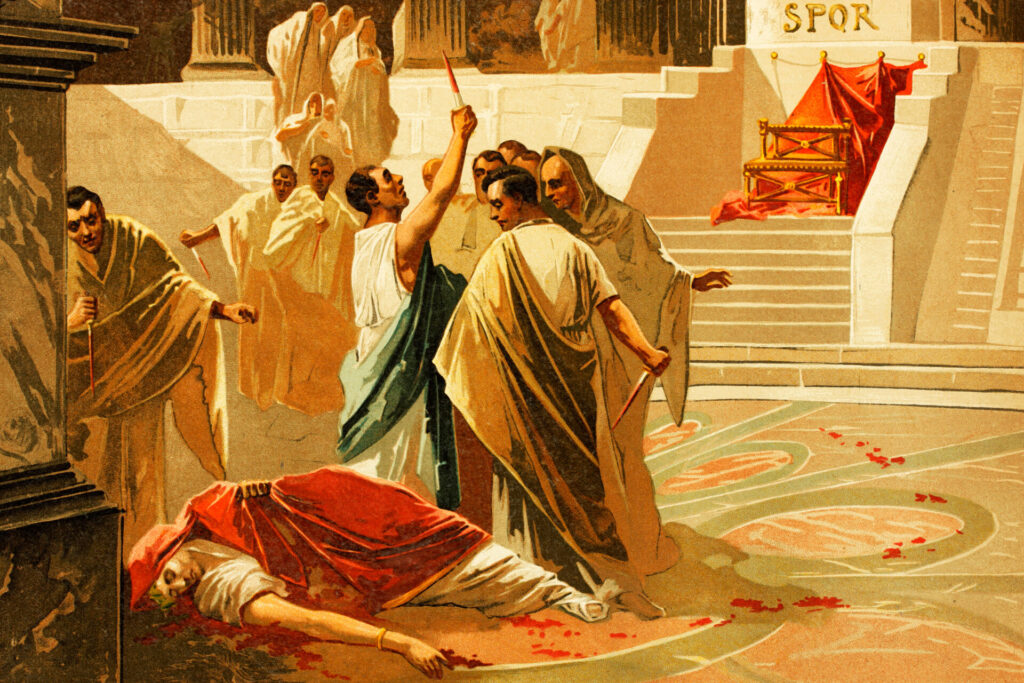
- On the Ides of March (March 15, 44 BCE), he was stabbed 23 times by a group of senators.
- The conspirators were led by Brutus and Cassius, men he considered friends.
- He died at the base of a statue of his former rival, Pompey.
Why it matters: The assassination was a final, desperate attempt to save the Republic. Instead, it plunged Rome into a new civil war and set the stage for the creation of an empire.
Julius Caesar’s Aftermath and Legacy
Caesar’s assassination was meant to restore the Republic, but it achieved the opposite, ensuring Rome would never return to its old ways. The power struggle that followed ended with Octavian, his adopted heir, emerging as Augustus, the first Roman emperor. In death, Caesar was elevated to divine status by the Senate, and his name endured for centuries as a symbol of supreme authority, passed down in the titles Kaiser and Tsar.
Guided Tours: Walk Through Caesar’s Rome
Want to step into Julius Caesar’s world? These tours bring you to the very places he lived, gambled, conquered, and died—with storytelling that cuts the fluff and delivers the history that matters:
Colosseum Underground Tour with Roman Forum and Palatine Hill
3 Hours | €€€
Get special access to the Underground dungeons and Arena Floor on this guided tour.
Book Now!
Special Access Colosseum Arena Floor Tour through the Gladiator’s Gate
3 Hours | €€
Walk in the footsteps of gladiators on the Colosseum floor and see the Roman Forum and Palatine Hill.
Book Now!
Rome in a Day Tour with Colosseum and Vatican Museums
7 Hours | €€€
Enter the Sistine Chapel, Roman Forum, and see St. Peter’s Dome, Pantheon, Trevi Fountain, and more!.
Book Now!Final Thoughts
Julius Caesar’s life was equal parts brilliance and brutality—an ambitious climb from the crowded streets of Suburra to the absolute peak of Roman power. His story isn’t just about military campaigns or political reforms; it’s about how one man’s choices shifted the course of history and ended a Republic that had lasted for centuries.
Ready to dig deeper into the world of Julius Caesar? Here are hand-picked blog posts that give you history, context, and the stories that matter:
What Was Life Like in Ancient Rome